Research Projects
Ongoing research in the Dynamics and Control Lab, organized into control theory, numerical study, hardware, and quantum sensing.
The Dynamics and Control Lab develops the mathematical foundations of dynamical systems and control and applies them to autonomous, networked, and sensing systems. Our work spans four areas: control theory, numerical study, hardware, and quantum sensing.
Control Theory
Semistability analysis
Many engineered and natural networks settle not to a single equilibrium but to one of a continuum of equilibria selected by the initial conditions — for instance, the common value reached by a consensus protocol. Semistability is the appropriate stability notion for such systems. We develop Lyapunov and geometric conditions for asymptotic, finite-time, and fixed-time semistability of nonlinear discrete-time systems, and apply them to multiagent coordination and network consensus.
Related publications: IEEE TAC 2022, Automatica 2022, SCL 2024, MED 2022, book chapter 2025.
Stochastic stability
Real systems operate under noise — sensor errors, random communication dropouts, and environmental disturbances. We extend Lyapunov stability and semistability theory to discrete-time stochastic dynamical systems, establishing theorems for stability, semistability, and ultimate boundedness in probability, with application to network consensus under random communication noise.
Related publications: Automatica 2022, IEEE TAC 2023, Automatica 2024, MED 2021, IFAC 2025.
Finite- and fixed-time stability
Classical asymptotic stability only guarantees convergence as time tends to infinity. For time-critical autonomy we study finite-time stability — convergence within a settling time that depends on the initial state — and fixed-time stability, in which the settling-time bound is uniform and independent of initialization. We develop both the stability tests and the optimal feedback controllers that achieve these guarantees for nonlinear, hybrid, and stochastic discrete-time systems. Most recently we study their digital realization: implicit- and consistent-discretization schemes that preserve exact finite- and fixed-time convergence under sampling, avoiding the chattering and loss of convergence that naïve discretization introduces.
Related publications: Automatica 2020, IEEE TAC 2022, IJC 2023, Automatica 2024, AIMS Math. 2021, MECC 2026 (implicit), MECC 2026 (consistent).
Nontangency analysis
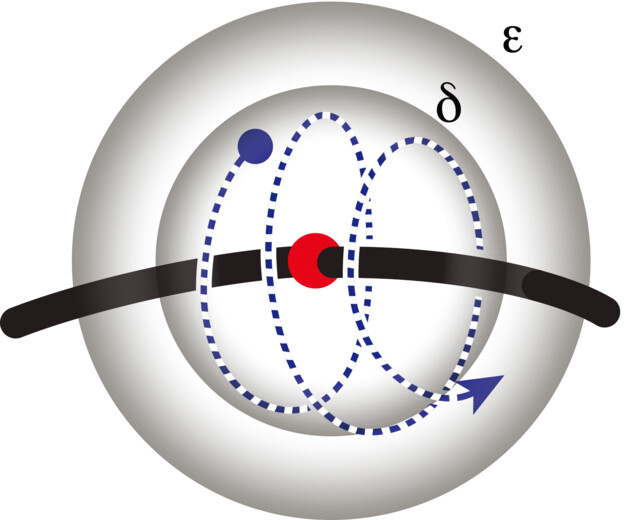
Certifying convergence and (semi)stability for nonlinear systems with a continuum of equilibria is difficult using classical strict-Lyapunov arguments alone. We develop nontangency-based tests — geometric conditions on how the system’s motion approaches the set of equilibria — that establish convergence and stability in discrete-time dynamical systems, complementing and in some cases relaxing standard Lyapunov requirements. We are extending these tests along two lines: arc-length–based conditions that certify convergence from summable displacements, and a unified taxonomy of convergence mechanisms for discrete-time network systems with continua of equilibria (such as consensus manifolds), aimed at protocols that enforce a favorable convergence mechanism by design rather than certifying it after the fact.
Related publications: SIADS 2025, ACC 2023, ACC 2025, CDC 2026.
Numerical Study
Thermodynamic particle swarm optimization
We design particle swarm optimization (PSO) algorithms grounded in thermodynamic and dynamical-systems principles for swarm robotics across ground and aerial platforms. Treating the swarm as a multiagent dynamical system yields distributed rendezvous, reconnaissance, and search behaviors with convergence guarantees. Recent work extends the framework from distributed rendezvous to target search in unknown, obstacle-filled environments, combining thermal-diffusion consensus, obstacle repulsion, and temperature-modulated Lévy-flight exploration, with the exploration–exploitation balance grounded in an entropy-based (thermodynamic) consensus theory.
Related publications: MECC 2025, IEEE/CAA JAS 2025, IMECE 2026.
Long-term autonomous missions
Sustained autonomy over hours or days requires reasoning at multiple timescales. Inspired by Dual Process Theory (DPT) from cognitive science — fast, reactive decision-making paired with slow, deliberative planning — we develop layered decision architectures for agents that must act reliably over long-horizon missions. We also study resource-aware long-horizon autonomy, coupling battery state-of-health with the decision layers so that mission planning adapts as usable capacity fades over season-long deployments.
Related publications: AIAA SciTech 2027.
Learning-based motion planning
Autonomous vehicles must plan safe motion through cluttered, partially unknown environments. We study reinforcement-learning approaches to quadrotor motion planning that produce collision-free trajectories in unknown obstacle fields, complementing the lab’s model-based control and planning work.
Related publications: IJCAS 2025.
Tether modeling
Tethered multirotor UAVs (TMUAVs) trade some mobility for effectively unlimited flight time and a secure, high-bandwidth data link, but the tether’s dynamics strongly shape vehicle stability and control. We model the tether — its sag, tension, unilateral slack-to-taut behavior, and coupling to the airframe — including retractable tethers whose reel dynamics and length-dependent stiffness change in flight, to enable accurate simulation and robust control design.
Related publications: Dynamics 2025.
Hardware
Swarm system using Thymio Wireless
We validate swarm-intelligence and PSO algorithms on physical multi-robot testbeds built from Thymio wireless robots, closing the gap between numerical study and real hardware that is subject to limited sensing, communication, and energy.

Related publications: MECC 2025, IEEE/CAA JAS 2025, IMECE 2026.
Battery-degradation–aware long-term agent
Battery capacity fades with use, changing what a long-duration mission can accomplish. We build hardware agents whose planning and control explicitly account for battery degradation, sustaining continuous field operation — such as long-term monitoring — as the onboard energy budget evolves.
Related publications: AIAA SciTech 2027.
Tethered MUAV & retractable TMUAV
We develop tethered multirotor UAV platforms, including retractable-tether systems, that combine the endurance and bandwidth of a physical tether with the agility of a multirotor. We design the robust and adaptive geometric controllers that fly these platforms with elastic, compliant cables — establishing closed-loop tracking guarantees despite the loss of differential flatness — and characterize their certified performance envelopes (bounds on payload swing and tracking error as the tether reels in and out) so that a mission planner can treat tether length as a first-class decision variable. Supporting simulation code and datasets are being released as an open, reproducible benchmark for tethered aerial autonomy (RTMUAV-Bench).
Related publications: Dynamics 2025.
Human-mountable fixed-wing UAV launcher
We design a flywheel-based, human-mountable launcher that stores and releases the energy needed to hand-launch a fixed-wing UAV, enabling rapid field deployment without a runway or fixed catapult. A first-principles energy-transfer analysis — modeling the friction drive as an inelastic momentum exchange — sets the efficiency ceilings and the binding design constraints, and is being validated on a benchtop testbed.
Quantum Sensing
NV-diamond quantum magnetometry
In collaboration with USC’s quantum sensing group, we develop room-temperature quantum magnetometers based on optically detected magnetic resonance (ODMR) of nitrogen-vacancy (NV) center ensembles in diamond. A confocal fluorescence system with microwave delivery sweeps the NV spin resonances, and a spectral-fitting pipeline reconstructs the full three-dimensional magnetic-field vector from a single compact sensor head by exploiting the four crystallographic NV orientations — calibration-free vector magnetometry referenced to the fundamental NV gyromagnetic ratio.
Geomagnetically induced currents & grid resilience
Severe geomagnetic storms induce quasi-DC geomagnetically induced currents (GICs) that can saturate high-voltage transformers and threaten the power grid. We develop the estimation and systems pipeline that turns magnetic-field measurements into grid-resilience assessments — mapping the surface geoelectric field through Earth-conductivity and grounded transmission-network models to per-transformer GIC and transformer-vulnerability scores — and study sensing architectures, from ground magnetometers to satellite-based NV-magnetometer concepts, for timely, spatially resolved nowcasting of geomagnetic disturbance.
Related publications: AIAA SciTech 2027.